Chaco Canyon: Why Native Leaders Are Fighting to Protect One of America’s Greatest Sacred Sites
Hidden in the high desert of northwest New Mexico lies one of the most extraordinary archaeological and cultural landscapes in North America: Chaco Canyon.
A thousand years ago, this remote canyon was the center of a thriving civilization. Massive stone structures rose four and five stories high. Sophisticated ceremonial complexes aligned with the movements of the sun and moon. Vast trade networks stretched across the American Southwest.
Today, Chaco Canyon remains sacred to many Indigenous communities, including Pueblo peoples, the Hopi Tribe, and Navajo communities.
But this ancient landscape is once again at the center of a battle — this time over oil and gas drilling.
The Ancient City at the Heart of the Southwest
Chaco Culture National Historical Park is far more than a collection of ruins.
Around a thousand years ago, Chaco Canyon served as a major ceremonial, economic, and cultural center for the ancestral Pueblo peoples. The site contains some of the largest structures built anywhere in North America before the modern era.
Some buildings rose four to five stories tall. Certain complexes contained 500 to 700 rooms. Roads, ceremonial centers, and connected settlements extended across a landscape spanning dozens of square miles.
Today, the site is recognized as a UNESCO World Heritage Site, but standing among the ruins still conveys something that designations cannot fully capture: awe.
During a recent cross-country trip through New Mexico, I made the long drive into Chaco Canyon. The journey itself felt like part of the experience — rough roads stretching across isolated desert terrain. After hours of travel, the canyon opened into one of the most remarkable archaeological landscapes I’ve ever seen.
You could spend days exploring it.
A Civilization Built on Engineering, Astronomy, and Ceremony
The people of Chaco achieved something extraordinary in a challenging desert environment.
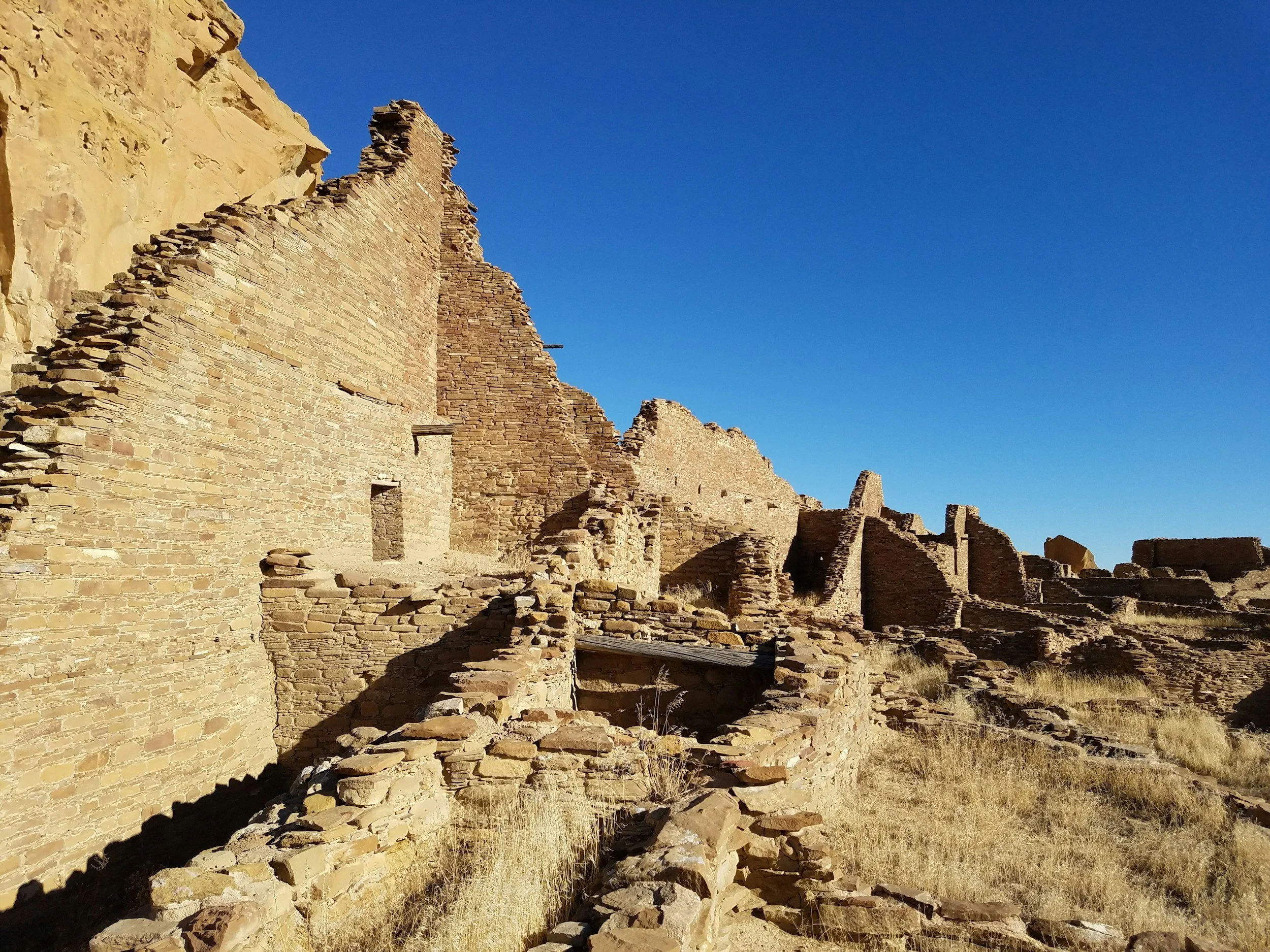
Using quarried sandstone and timber hauled from great distances, they constructed monumental complexes unlike anything else in North America at the time. These “great houses” functioned as centers of community, ceremony, administration, and cultural life.
Among the most famous is Pueblo Bonito, the largest and most significant structure in the canyon complex.
Covering roughly two acres and containing approximately 650 rooms, Pueblo Bonito is a staggering achievement of ancient architecture. Inside were ceremonial spaces known as great kivas — large, partially subterranean circular structures used for meetings, spiritual gatherings, and communal rituals.
Kivas played a central role throughout Chaco society. These structures were not incidental additions. They were woven deeply into the planning and social organization of the settlements.
The Ancient Sky Knowledge of Chaco Canyon
One of the most fascinating aspects of Chaco Canyon is its connection to astronomy.
The builders carefully aligned major structures with the movements of the sun and moon. Research conducted through collaborations involving the Solstice Project and the National Geodetic Survey found that sites like Pueblo Bonito were built along precise axes that correspond with important solar events, including the equinoxes.
Why did so many ancient civilizations — from the Maya to the ancestral Pueblos — devote such careful attention to celestial patterns?
Some scholars suggest that the heavens represented something deeply important: order, predictability, and cosmic structure.
In a world shaped by agricultural cycles, seasonal timing, and spiritual cosmology, the movements of the sky may have carried practical, ceremonial, and philosophical meaning all at once.
A Vast Trade Network in the Ancient Southwest
Chaco Canyon was not an isolated settlement.
By around 1050 CE, it had become a major regional center within the San Juan Basin, connected through trade, roads, and ceremonial relationships that stretched across the Southwest.
Archaeologists have identified road systems extending up to 60 miles, engineered with surprising sophistication and often built in remarkably straight lines across difficult terrain. Some researchers believe these roads helped transport materials such as timber from forests many miles away.
One of Chaco’s most important resources was turquoise.
Archaeologists uncovered approximately 200,000 pieces of turquoise at Chaco sites, including workshops used to manufacture beads, pendants, ceremonial objects, and burial goods. In some burials, thousands of turquoise artifacts were found together.
The scale of this trade network reveals a society that was highly connected, organized, and culturally influential.

Why Was Chaco Canyon Abandoned?
Like many great ancient centers, Chaco Canyon eventually declined.
Beginning in the 13th century, many settlements, houses, and surrounding population centers were abandoned. Researchers widely believe that prolonged drought and environmental stress played major roles. The landscape may no longer have been able to support its growing population and resource demands.
But Chaco Canyon did not disappear.
Its descendants are alive today.
Modern Pueblo peoples, Hopi communities, and other Indigenous nations continue to recognize Chaco as an ancestral and sacred place. It is not simply a historic ruin frozen in the past. It remains part of living cultural identity.
The Modern Battle Over Oil and Gas Development
That living connection is central to today’s controversy.
In 2023, the federal government established a 10-mile protective buffer zone around Chaco Culture National Historical Park to limit new oil and gas leasing near the site for twenty years. The goal was to help protect one of the most culturally significant Indigenous landscapes in North America.
Now, efforts to weaken or remove those protections have sparked fierce opposition.
Tribal leaders, Indigenous advocates, and New Mexico representatives have pushed back strongly against proposals that would reopen nearby lands to drilling activity. Representative Melanie Stansbury and others have publicly opposed changes that could expose the area to expanded oil and gas development.
The message from many Indigenous leaders has been clear:
“Chaco Canyon is not for sale.”
Why Chaco Canyon Matters
Chaco Canyon is more than an archaeological treasure.
It is one of the most important Indigenous ceremonial landscapes in North America. It is a place where architecture, astronomy, ecology, spirituality, and human ingenuity converged a thousand years ago in the desert Southwest.
The debate surrounding Chaco raises larger questions that extend far beyond New Mexico.
How should societies protect sacred Indigenous places?
What responsibilities do governments have toward ancestral landscapes that continue to hold deep cultural meaning today?
And how do we balance resource extraction with the preservation of irreplaceable heritage?
Standing among the massive stone walls of Chaco Canyon, it becomes difficult to view these questions as abstract policy debates.
This is not simply land.
For many communities, it is memory, ancestry, ceremony, and identity embedded into the desert itself.
The struggle to protect Chaco Canyon is not only about preserving ancient ruins.
It is about deciding what kind of history — and what kind of future — we choose to honor.